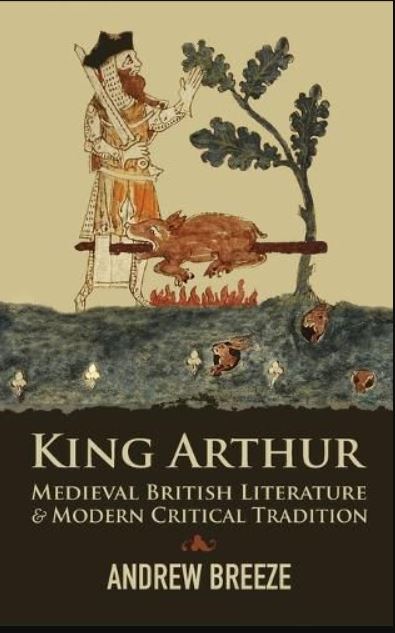
15th October 2026, The ‘Real’ King Arthur, Andrew Breeze, FRHistS, FSA, Author and Historian (All talks held at Holy Trinity Church, Church Street, Haddington at 7.30pm. Doors open at 7pm)
THE REAL KING ARTHUR AND SIXTH-CENTURY SCOTLAND
The problem of King Arthur, whether he existed and (if he did) where that was, can now be given a definitive solution. There are three major sources: the ninth-century Welsh-Latin Historia Brittonum; the slightly later Annales Cambriae; and early genealogies of Northern and Welsh royal dynasties. They let us say the following.
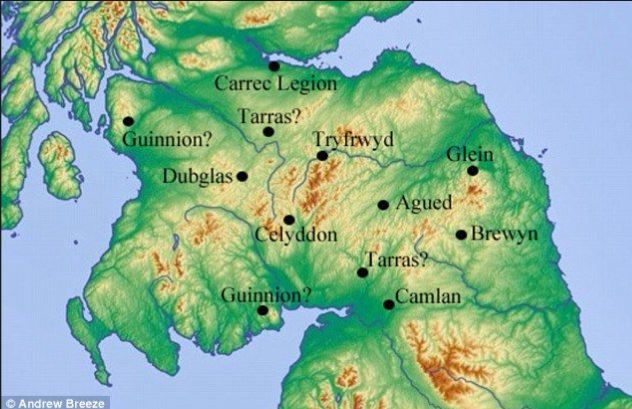
Historia Brittonum in its chapter 56 has a list of Arthur’s Twelve Battles. These have puzzled scholars since medieval times. Yet comparison with The History of the Celtic Place-Names of Scotland (1926) by Professor William J. Watson provides answers, in some cases with emendation of toponyms that have suffered scribal corruption. They let us place eleven of the battles between Forth and Tyne, with four of them on Douglas Water, near Lanark, and others near Beattock, or on the River Glen, Northumberland. Implication: Arthur had no link with Wales or Cornwall, but fought his campaigns in North Brittain.
Annales Cambriae also gives us a date. It states that Arthur was killed at Camlan in 537, and this has long been identified with the fort of Camboglanna on Hadrian’s Wall, a stronghold which since the 1970s has been taken to be Castlesteads, Cumbria. There is a further implication. The years 536-537 were those of a ‘volcanic winter’ and famine throughout the Northern Hemisphere (following a mega-eruption in the Americas), not least in Britain and Ireland, as also stated in the Welsh-Latin annal for 537. It suggests that Arthur’s ‘battles’ were raids for the cattle of Rheged and Gododdin in a time of mass starvation, first making him a hero in Strathclyde, and (after his death) a legend. Arthur thus had nothing to do with the British victory of ‘Mount Badon’ over the West Saxons. It is to be located at Braydon in north Wiltshire, and in the year 493. It is in the wrong place and the wrong year to be attributed to Arthur.
The upshot is that Arthur existed; he was a North Briton; he was not a king but a ‘dux bellorum’ (better dux bellatorum ‘captain of warriors’ or, in Welsh terms, a penteulu ‘captain of the royal host’). He did not fight the Anglo-Saxons; his activities were limited to the North; he was not a Roman commander, still less an emperor; his name was yet of Latin (not Celtic) origin; his fame was such that it was given to later princes in Celtic Britain. He would have spoken British and Latin. In short, his cultural identity has a parallel in the Yarrowkirk inscription from Selkirkshire/Borders, an epitaph (also of the early sixth century) which commemorates two princes with British names, whose royal father was called Liberalis. Like Arthur, his neighbour and contemporary, Liberalis will have been a North Briton with a culture partly Latin, partly Celtic. Scots may thus boast that Arthur was one of them; and that it was sixth-century Scotland (not Wales or Cornwall) that gave to the world the supreme narrative of Arthur, valiant Northern commander.
Andrew Breeze
Here is a map of Arthur’s main battles.
Biography
Andrew Breeze was educated at Sir Roger Manwood’s School, Emmanuel College, Cambridge (where he took a first in English in 1974 and in Anglo-Saxon, Norse and Celtic in 1976,[3] and his PhD in 1992), and at St John’s College, Oxford (where he took a diploma in Celtic studies in 1978).[4] In 1986, he worked as a scholar for the Dublin Institute for Advanced Studies at the school of Celtic Studies.[5]
Andrew’s most recent books are:
- 2020 British Battles 493–937: Mount Badon to Brunanburh, Anthem (ISBN 1 78527 223 3)
- 2023 The Historical Arthur and The Gawain Poet: Studies on Arthurian and Other Traditions. Rowman & Littlefield. (ISBN 978 1 66692 954 6)
- 2024 Englands Earliest Woman Writer and other Studies on Dark Age Christianity
You must be logged in to post a comment.